
The unsaid things in your closest relationships are quietly costing you more than you know
By Grant Ballard-Tremeer, PhD • Author
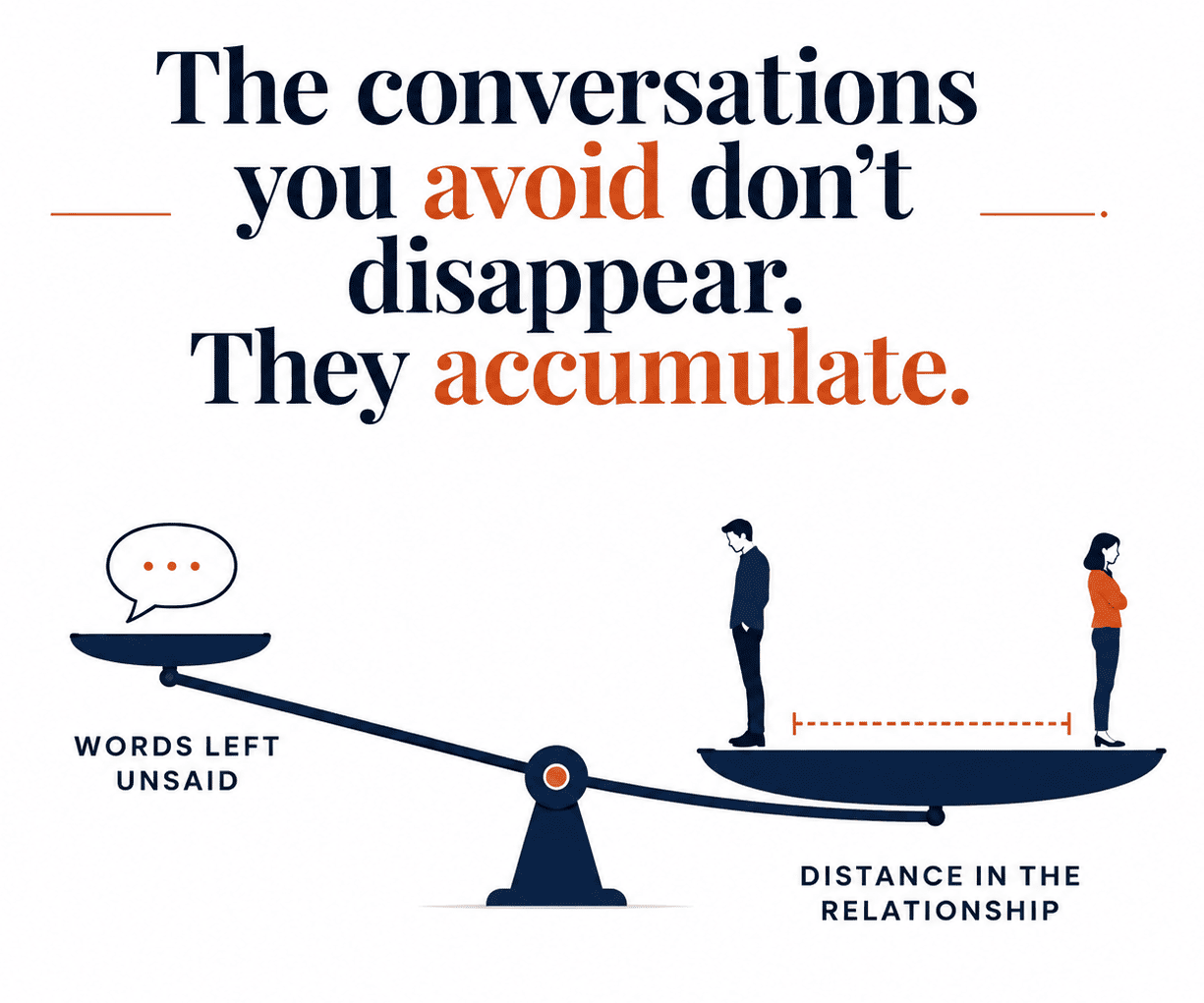
Almost every meaningful relationship in your life is being quietly shaped by the things you meant to say and didn't. It’s not one big withheld truth but a slow accumulation of small ones. The thing you were going to raise and then didn't, the message you drafted and never sent, the moment you decided to let something pass rather than name it.
Each individual choice felt reasonable. Perhaps the timing was wrong, or they were stressed, or you weren't sure how it would land. But the choices compounded and the shape of the relationship you now have with your partner, your parent, your closest colleague, or your oldest friend is significantly influenced by the specific things you meant to say to them and didn't.
I want to walk you through what actually happens in the moment you decide to hold something back, why it feels reasonable every time, what it is actually protecting, and a specific four-step practice for finally offering one of the things you have been quietly withholding.
What you have been withholding is actually protecting you
We tell ourselves the unsaid thing is being held back to protect the other person from being hurt, from being caught off guard, or from receiving something at the wrong moment. Almost never is that what's actually happening.
What you are withholding is protecting you. Once said, the thing becomes evidence. Evidence of what you actually believe, evidence of what you actually want, evidence of what you were, in fact, willing to say.
That evidence carries a specific cost. The other person now knows something about you they did not know before. Your relationship with them shifts, sometimes toward repair, sometimes toward difficulty, sometimes toward something entirely new. Whichever way it moves, you cannot un-move it.
The unsaid thing, as long as it stays unsaid, protects you from that irreversibility. As long as it remains inside you, you can still be the person who has not yet said it. You can still be, in some quiet way, in the same relationship you were in the day before you noticed the thing needed to be said.
This is the trade you have been making one held-back sentence at a time, in every relationship of your life. But it is not free. Each unsaid thing is a small transaction where you exchange the possibility of a changed relationship for the safety of an unchanged one. And the accumulated cost of these trades, across years, is the specific shape of the professional and personal life you now have.
The four-step practice for finishing one such conversation this week
Choose one thing you have been holding back. One specific unsaid thing, in one specific relationship. Do not try to do all relationships at once. Pick the one where the weight of what you have been carrying has become the hardest to keep carrying.
The practice takes about twenty minutes.
Step one: Name the specific relationship the withholding protects.
Sit with the question: what is the version of this relationship I currently have, the version that exists as long as this thing stays unsaid? Write two or three sentences about it. Include the specific ways the current relationship is comfortable, and the specific ways it is quietly costing you something.
Most people find, doing this, that the current relationship is significantly less stable than they had told themselves. The thing has been unsaid not to protect a good relationship, but to preserve a familiar one.
Step two: Name the kind of relationship the said thing would create.
Now imagine you have said it. The person has heard it. Some time has passed. Write two or three sentences about the new relationship. Not the immediate reaction, but the shape it takes six months on. Include the specific ways it might be harder, and the specific ways it might be more honest.
Most people find, doing this, that the imagined future relationship is significantly less catastrophic than they had feared. The offering produces change, but the change is usually more workable than the mind had been telling them.
Step three: Name what you actually want to say - CLEARLY
Now, write down the specific thing. Not the softened version, not the way you have been rehearsing it in your head, but the clean version. The thing the earlier version of you (the one who first noticed this needed to be said) would have said, before ten thousand small edits softened it into something you could carry indefinitely without ever offering.
Step four: Offer it
Not tomorrow or later this week, but now, while the practice is still active in you.
If the relationship is close and physically present, this may be a conversation you have today. If it is at a distance, this may be a message you send whether through an email, a text,or a written note. The medium matters less than the offering.
What matters is that the underneath work has been done: you have named what the current relationship costs, imagined the future one, and clarified what you actually want to say. Offering it is now the smallest possible remaining step.
The relationship that emerges on the other side will not be the one you had. It will be a different one, often better, sometimes harder, always more real. That is the point.
This is the kind of transformation I've been writing about in my upcoming book
The unsaid thing is a small case of a much larger pattern. It is the specific, isolated example of the phenomenon my forthcoming book, The Zero-Sum Illusion, is built around: the way our closest relationships slowly become curated versions of themselves, held in place by the small honesties we have quietly decided not to offer.
The book walks through this pattern at scale in marriages, in workplaces, in families, in the broader collapse of our capacity to have the conversations that used to hold things together. And it offers a specific set of practices, of which the four-step move above is one small application, for interrupting the pattern before it has quietly determined the shape of a life.
— Grant
Explore the Complete Framework
This essay is adapted from the core concepts of the upcoming book, The Zero-Sum Illusion.
Be among the first to hear when pre-sales start and receive exclusive preview chapters directly in your inbox.